




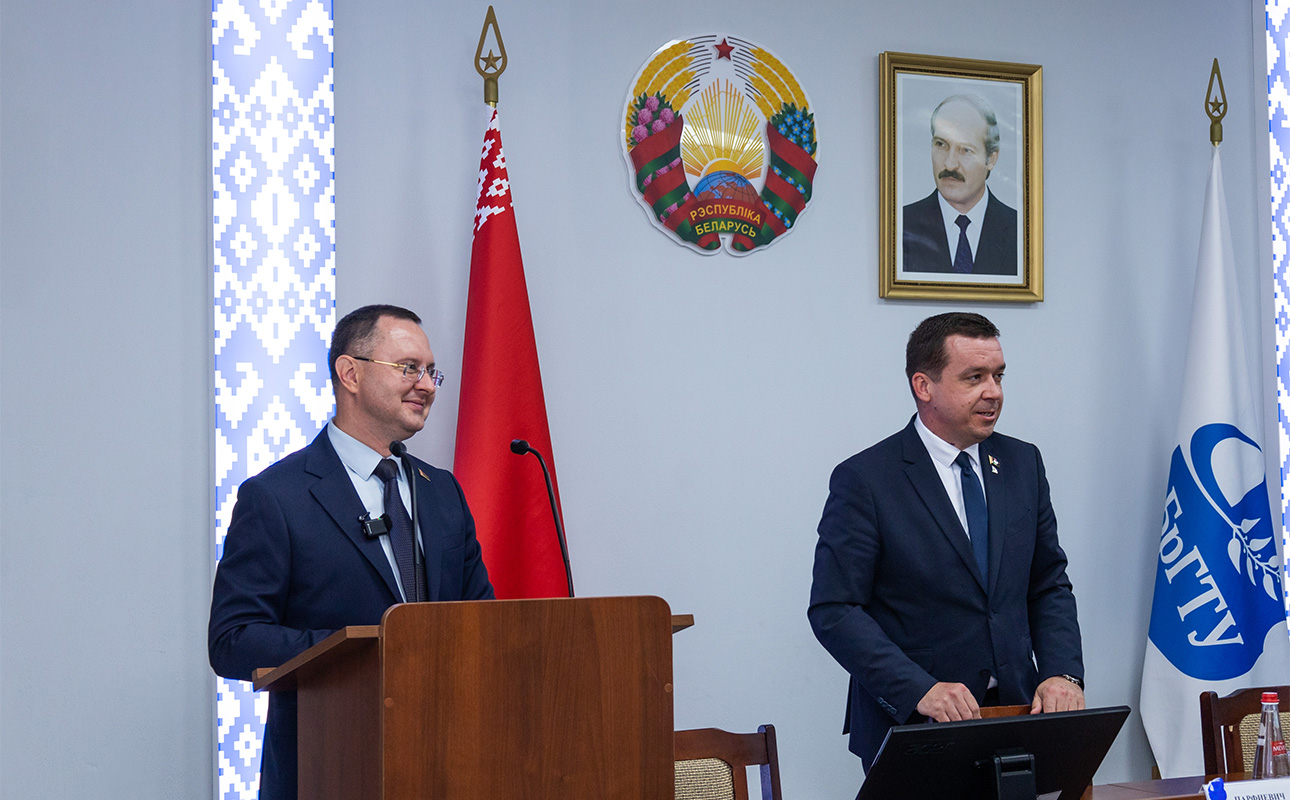
On October 15, 2026, Brest State Technical University (BrSTU) hosted an important meeting as part of the "Unified Information Day," centered on the theme: "Traditional Values of Belarusians: Family, Society, and the State." The guest speaker was the Chairman of the Brest City Executive Committee, Sergey Nikolayevich Lobodinsky.
Opening the session, BrSTU Rector Andrey Nikolayevich Parfiyevich highlighted the significance of the topic and the value of direct dialogue between young people and government officials.
"Today, the focus is placed on the family, society, and the state—three pillars, three foundations upon which all of life is built. These are the elements we encounter every single day," Andrey Nikolayevich remarked to the audience.
In his address, Sergey Nikolayevich emphasized that the family, society, and the state form an inseparable chain that determines the well-being of the nation. He also noted that the comfortable urban environment—a source of pride for Brest today—is the result of tremendous effort.
The head of the city spoke in detail about state policy regarding demographics, stressing that a strong family is a matter of national security.
"Each of us must recognize that traditional values—family, society, and the state—are among our most fundamental assets; they are the bedrock upon which we all stand. We often fail to consider just how vital the family unit is to our society. Furthermore, looking at our Constitution, it is clear that, historically, our society has been built upon the traditional family—a union between a man and a woman."
Sergey Nikolayevich presented specific figures illustrating the demographic situation in Brest. He noted that the average age at which people marry has risen significantly in recent years: it is now 31 for men and 28 for women. Meanwhile, Brest remains one of only two regional centers in the country that have seen population growth since 2016 (reaching 347,000 as of January 1), though this is driven primarily by migration rather than birth rates. Today, the city is home to 5,169 large families, raising a total of nearly 17,000 children.
In his remarks, Sergey Nikolayevich detailed the support measures implemented by the state to maintain the population and ensure the nation's health. These include the development of longevity-focused medicine, the operation of perinatal centers that provide specialized care for newborns, and the expansion of inclusive education. He also specifically addressed assisted reproductive technologies: while families were previously entitled to only one free attempt at in vitro fertilization (IVF), the state now offers the opportunity to pursue parenthood twice. Thanks to these initiatives, more than 2,500 children have been born at the "Mother and Child" National Research Center.
Social protection remains a fundamental pillar of support. "The most significant component is, of course, support for motherhood. This primarily concerns pregnancy and childcare allowances for children up to the age of three. A woman who gives birth receives a one-time birth grant, followed by a childcare allowance for the next three years—a substantial amount. Furthermore, the 'maternity capital' program has played a vital role, enabling families to exercise their right to secure housing."
The Chairman of the City Executive Committee also placed special emphasis on the importance of setting a personal example. He shared his family’s traditions with the young people, emphasizing that maintaining harmony at home while holding a high-ranking government position is a matter of effective time management and clear priorities. He also touched upon the subject of patriotism, underscoring the importance of preserving historical memory and respecting the value of hard work.
The highlight of the formal portion of the meeting was a special congratulatory segment. Sergey Lobodinsky personally offered his best wishes to two young couples from the Brest State Technical University (BrSTU) who had recently married, presenting them with commemorative gifts on behalf of the City Executive Committee.
Following his main address, a lively dialogue ensued. The students did not hesitate to ask pointed and pressing questions. They inquired about the city administration’s plans for the future development of Brest, how an official in such a high-ranking position balances an immense workload with his roles as a husband and father, and which specific family traditions help him sustain his energy. Sergey Lobodinsky provided detailed and candid answers to every question, affirming that an open dialogue with the youth is the best way to communicate state policy and understand the needs and aspirations of the new generation.
